The elusive truth behind the second-hand export debate

Updated: Oct 10, 2025
A wave of policy changes is currently underway in the EU, aimed at tackling the environmental damage caused by the textile industry. Yet early signs suggest these reforms may be making the problem much worse. One of the reasons might be that some of the data it is based on, is flawed.
It has been claimed, that the export of second-hand clothing to African countries is in fact a way for European countries to dump unwanted clothing waste. Nearly all reports on the subject come from Ghana. So we decided to go there.
This is what we found—or perhaps more accurately, what we didn’t.
There is no doubt that the textile industry is among the most climate-damaging sectors. The environmental impact of clothing production is immense, and garments are increasingly made from synthetic, plastic-based materials. Add to that the massive overconsumption of clothing in the Global North and the mountains of textile waste it produces.
But in recent years—since 2021, to be precise—a relatively small part of the textile industry has come under the spotlight: the trade and handling of second-hand clothing. Despite the fact that the second-hand sector arguably extends the lifespan of textiles, redistributes surplus clothing from the Global North to the Global South, and contributes both to job creation and affordable clothing for comparatively poorer populations, it has become the target of growing criticism. Why?
Media coverage of textile waste Media outlets about textile waste
The truth about the second-hand export debate not quite as it usually is described in media
Claims of 40% waste in exports
Critics argue that the problem lies in the quality of second-hand clothing exported from Europe to countries in, for example, Africa. A significant portion of these garments are said to be unusable—torn, dirty, or otherwise unfit for resale—and are therefore discarded as waste upon arrival. The figure most commonly cited in debates is that around 40% of second-hand clothing imports to African countries are considered unwearable and thus treated as waste.
This exacerbates an already difficult waste management problem in African countries. The prevailing narrative that has gained traction in mainstream media, social media, debates, and conferences is that "Europe is dumping its clothing waste in African nations".
Where are the mountains of waste?
There is only one way to find out whether the claims about imported textile waste are true: go to Accra and visit the places where the waste is said to be. So this is what we did.
We meet up with "Kevin" on one of Accra’s beaches. He says he has guided many TV crews to the places where textile waste can be found. For a small fee, he can guide us too, we gather. So the next day, we follow him to the beaches of Jamestown—perhaps the most frequently featured location in reports about second-hand waste in Ghana.
When we arrive, the beach is full of young people picking up litter and trash. The cleanup is organised by the OR Foundation, a non-profit based in Ghana and run by two Americans. The foundation is one of the main forces behind the portrayal of Ghana as a dumping ground for the Global North’s clothing surplus.
But the litter being collected on the beach, with few exceptions, isn’t clothing.
Unsurprisingly, it’s almost entirely plastic.

Volonteers cleaning up Jamestown beach in Accra. A place said to be overflowed by textile waste.
But in fact, most of it is plastic.
It's not textiles, it´s plastic bags
Kevin tells us that all the clothing has already been cleared from the beach. There are other places, he says, where we’ll be able to see the piles of clothing. So we head to another beach. But again, there are no textiles. We continue upriver, passing Korle Lagoon—another location frequently mentioned in reports about textile waste. Here, we find large amounts of litter. But very little of it is textile.
At first sight the trash on the beach look like old clothes and textiles, and there are som pieces, but almost all of it is plastic. And particularly plastic bags. Plastic bags looks a lot like textiles from a distance.
There are many landfills and dumping sites along the river. It’s been said that when it rains, clothing waste is washed along the river and out into the ocean. But nowhere do we find any mountains of textile waste.
In some places, from a distance, it may look like clothing waste—but as we get closer, it becomes clear that it’s plastic. Plastic bags, from afar, can very easily be mistaken for textiles.

There are some garments here and there at the beach, but it is estimately only
a few percent of the total amount of waste.
We visited all the places in Accra that are said to be where unwanted, discarded second-hand clothing ends up. We went to the beaches, we visited the dumping sites, we climbed onto and around several landfills, and we followed the river that runs through the city. But nowhere did we find any evidence that Ghana is a dumping ground for Europe’s cast-off clothing.
On the banks of the river that runs trough Accra there is a lot of waste. But most of it is plastic.
Nowhere are the mountains of textile waste to be found.
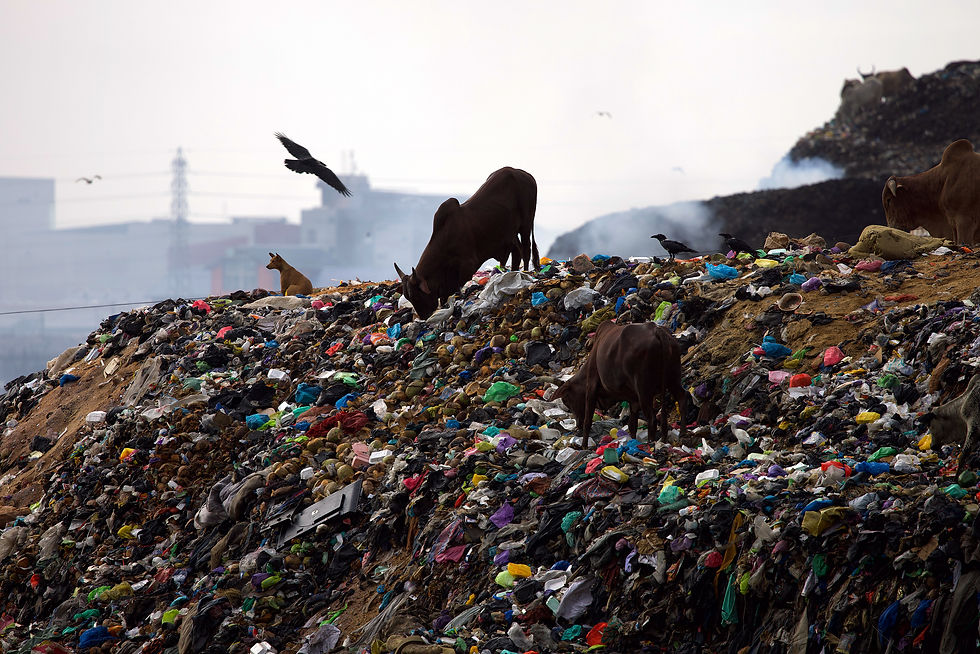
It might look like textiles from a distance, but as you get closer, you discover that textiles is a very small part of it
As we travel around trying to locate the textile waste reported on by media outlets around the world—and which has, to a large extent, shaped EU policies and regulations on second-hand clothing—it’s hard to understand how things ended up this way. Even if the beach we visited had truly been cleared of clothing, all the other places we’ve seen should be overflowing with textile waste, if the media coverage is to be believed.
We leave Ghana puzzled. How did this happen? Who stands to gain from it?
We’ll be back with more soon.
Written and produced by
Thomas Lundkvist & Kristjan Sigurjonsson
More to watch:
More to read:
What does the traders say?

We meet Edward Atobrah Brinkley. He is the Secretary General of the Ghana Used Clothing Dealers Association, an organisation representing importers and retailers of second-hand clothing in Ghana.
"Claims that 40% of second-hand imports end up as waste have been circulating in the media for years. But those of us who live and work in this industry have never been able to understand where these so-called mountains of clothing waste are. We've really searched—but we haven't found them," he says. “Every country has textile waste—and so do we,” says Atobrah. “But the waste consists of clothes that have been worn many times and then discarded. It doesn’t come from second-hand imports.”
“Our research shows that textile waste makes up just a few percent of total waste,” he says.
We learned that one such study was carried out by the Metropolitan Research and Education Bureau, which concluded that no more than 5% of imported second-hand clothing could be considered waste. You can read that study here.
Protests in Ghana

This is exactly what importers and second-hand clothing traders in Ghana have been trying to say for years, but nobody want's to listen, as it seems. They argue that the reported volumes of waste supposedly generated by second-hand imports are completely inaccurate—and that the mountains of textile waste said to exist in Accra simply do not.
As recently as March 2025, hundreds of people working in Accra’s second-hand industry took to the streets to protest what they claim is a deeply misleading portrayal of the trade. Their frustration is understandable: such claims threaten not only their livelihoods, but their very ability to earn a living and live with dignity.
2,180 shipping containers of textile waste
The images and reports in media appear convincing.
The message is that nearly half of Ghana’s imports of second-hand clothing are unusable and end up directly in landfills and on beaches. But to anyone with even a basic understanding of how the second-hand clothing trade works, this claim sounds both unlikely and illogical.
Ghana imports over 130,000 tonnes of second-hand clothing each year. If 40% of that were waste, it would amount to around 2,180 shipping containers annually—or roughly 182 containers every month. That’s a vast amount of textile waste.
But it would also mean that importers are unable to sell half of what they bring in—a remarkably bad deal by any measure. Especially considering they pay both duties and taxes to bring the clothes into the country.


Comments