How the myth of textile waste is reshaping a global circular system

Updated: Jun 16
We travelled to Ghana looking for the mountains of textile waste that have become famous around the world. We did find waste. A lot of waste. But what looked like mountains of discarded clothing turned out to be something else. Plastic.
That discovery became the starting point for a deeper investigation. Because if the images at the centre of the textile waste debate are not showing what people think they are showing, what else might be wrong?
Over the past year, Reuse News has followed that question from the beaches of Accra to the heart of global policymaking. What we found raises fundamental questions about one of the most influential narratives in the circular economy.
Over the past year, Reuse News has investigated the claims behind the textile waste narrative.
We travelled to Ghana. We interviewed traders, importers, researchers, policymakers and industry representatives. We reviewed studies, reports and policy proposals that are now helping shape the future of the global textile trade.
What we found raises fundamental questions about one of the most influential stories in the circular economy.
First discovery: The mountains of textile waste were nowhere to find
Images from Accra, Ghana have become some of the most widely used evidence supporting claims that second hand clothing exports are creating an environmental crisis. From a distance, the images appear devastating. Vast accumulations of waste seem to consist of discarded garments.
But when we visited the locations repeatedly used to illustrate the problem, a different picture emerged.
There was waste. A lot of waste. But not textile waste.
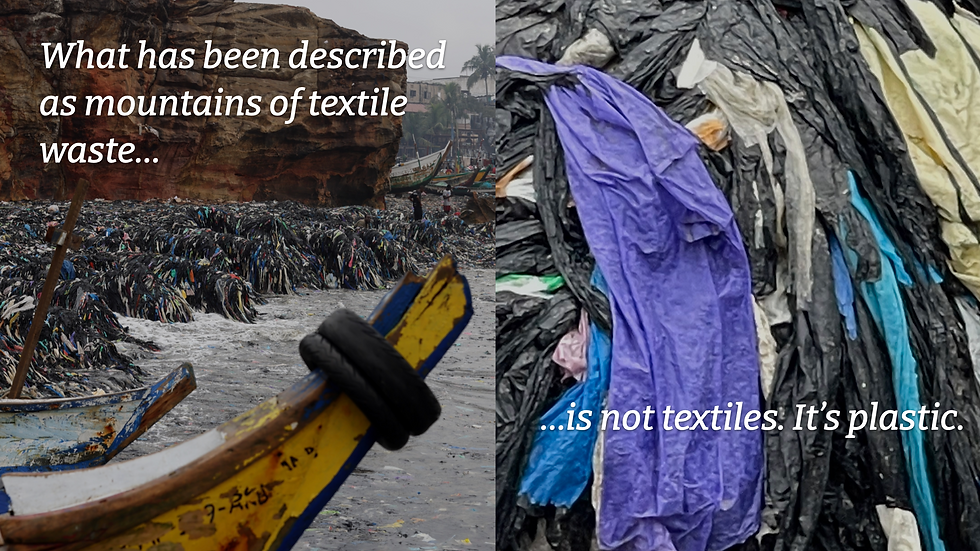
What appeared to be textile waste from afar turned out to be plastic bags, packaging and other non-textile debris when examined up close. The textile mountains that have become central to the global narrative were nowhere to find.
What we found on the ground was also reflected in the reactions of the people who work in Ghana's second hand trade. Importers, traders and market organisations repeatedly told Reuse News that they do not recognise the picture that has been presented in international media.
Many expressed frustration at seeing Ghana portrayed as a dumping ground for foreign textile waste.
"If 40% of what you import would be trash and unsellable, you wouldn't be able to stay in business for very long. It just doesn't make sense," says Marlwin Owusu of the Ghana Used Clothing Dealers Association.
Others pointed to a growing disconnect between what is being reported abroad and what they experience every day in the market. For many traders, the issue is no longer only about waste. It is about how an entire industry, and the livelihoods that depend on it, are being portrayed to the rest of the world.
Read the full investigation: What looks like mountains of textile waste, is actually not. It's plastic.
Second discovery: The economics don't add up
The most widely repeated claim in the debate is that up to 40 percent of imported second hand clothing becomes waste. If true, the implications would be enormous. But there is a simple question that is rarely asked:
Who would make money from that?
The second hand trade is not a charity system. It is a global commercial network involving collectors, sorters, exporters, shipping companies, wholesalers and traders. If nearly half of all imported clothing immediately became worthless waste, somebody would be absorbing catastrophic losses.

Yet traders, importers and market organisations consistently describe a functioning business built around selling products, not importing waste. As one importer told us: "We can't be in business spending good money to import goods only to end up selling 60 percent and throwing away 40 percent."
Read the full investigation: The missing logic behind the textile waste claims
Third discovery: Nobody can explain the business model
Environmental scandals usually follow a familiar pattern. Somebody profits. Somebody saves money. Somebody benefits from shifting costs onto someone else. That logic has become central to the textile waste narrative.
But when Reuse News searched for evidence of a large scale business model built around exporting textile waste from Europe to Africa, we found something unexpected. We found assumptions, theories and concerns.
But we found remarkably little evidence explaining how such a system actually operates.

There are no no verified commercial models or clear evidence showing that exporting textile waste is more economically attractive than disposing of it domestically. The business behind the narrative remains surprisingly difficult to identify.
Read the full investigation: Everyone talks about textile waste exports. Nobody can explain the business model.
Fourth discovery: The narrative is already changing policy
Across Europe and internationally, policymakers are now developing new rules governing textile collection, sorting and exports. And much of it is based on the assumtions about the textile waste export.
Discussions within the Basel Convention could fundamentally change how used textiles move across borders.
New regulatory frameworks are being designed to stop waste exports.
Several experts interviewed by Reuse News warn that policies intended to solve one problem could unintentionally damage one of the world's largest circular systems.

The question facing policymakers is no longer simply whether textile waste exists.
The question is whether the evidence is strong enough to justify reshaping an entire global reuse system.
Read the full investigation: How did an unverified claim become a global truth and reshape global policy?
Fifth discovery: A narrative became an ecosystem
One question remained throughout our investigation. If the evidence was weaker than commonly assumed, how did the textile waste narrative become so influential?
The answer leads back to a small number of organisations that helped shape and promote the story over many years. Among them, none has been more influential than The OR Foundation.
The organisation played a central role in popularising the claim that up to 40 percent of imported second hand clothing becomes waste, a figure that would later be repeated by international media, advocacy groups and policymakers around the world despite remaining heavily disputed.
As the narrative gained influence, so did the organisation behind it. During the years when textile waste became a global policy issue, The OR Foundation's revenues increased by millions of dollars. In 2022, the organisation also received a $15 million commitment from Shein, one of the world's largest ultra fast fashion companies.
That is a striking paradox.
Claims that remain central to global textile policy discussions continue to be disputed, while the organisations promoting those claims have become increasingly influential, visible and well funded.
Read the full investigation: The NGO behind the textile waste narrative and the millions that followed
The question that remains
This investigation shows that one of the most influential narratives in the global textile debate may rest on assumptions that have received far less scrutiny than the policies now being built around them.
A claim became a headline. The headline became a narrative. The narrative became a policy concern.
The policy concern became a regulatory agenda.


Comments