The NGO behind the textile waste narrative and the millions that followed

For years, policymakers, journalists and campaigners have repeated claims that up to 40 percent of second-hand clothing imported into Ghana becomes waste.
The claims originated with the OR Foundation, a Ghana-based NGO that has become one of the most influential voices in the global textile waste debate. Despite being widely cited, the figure has never been independently verified and remains heavily contested.
And as these claims gained influence around the world, The OR Foundation grew from a relatively small NGO into an organisation with annual revenues exceeding $8 million and received millions of dollars from funders including ultra-fast-fashion giant Shein.
This article is part of Reuse News' ongoing investigation into claims surrounding the alleged textile waste crisis in Ghana. Reuse News has reported that several locations frequently presented internationally as evidence of a textile waste crisis consist predominantly of other forms of waste, particularly plastics. We have also found that robust independent studies verifying the waste volumes commonly attributed to second-hand clothing imports remain largely absent. Previous articles: What looks like mountains of textile waste, is actually not. It's plastic.
The missing logic behind the textile waste claims The rise raises an obvious question.
How did one organisation become both a leading source of information about a global environmental crisis and one of the largest recipients of funding linked to it?
The project that changed the conversation
The global spread of the 40 percent claim began with Dead White Man's Clothes, a 2021 multimedia project published by The OR Foundation. The project presented a stark picture of the global second-hand clothing trade. Images showed beaches, waterways and dumping sites apparently covered with discarded clothing. Market traders described increasing difficulties handling unsold garments.
Its most influential claim was that up to 40 percent of imported second-hand clothing effectively became waste.
That figure spread rapidly.

Major media outlets repeated it. NGOs cited it. Researchers referenced it. Policy reports adopted it.
Within a few years, the number had become one of the defining facts of the global textile waste debate.
As international attention grew, The OR Foundation increasingly became one of the primary sources through which journalists encountered the story. Major international outlets relied on the organisation for interviews, local context, research, access and visual documentation. In many cases, the same images, statistics and framing travelled together.
Yet Dead White Man's Clothes was not a peer-reviewed academic study.
It was a multimedia research and storytelling project built primarily around interviews, observations and visual documentation. Despite this, the figure became widely treated as established fact.
Before Dead White Man's Clothes
The ideas behind the project did not emerge from nowhere.
Five years before Dead White Man's Clothes was published, OR Foundation co-founder Branson Skinner submitted a master's thesis examining the second-hand clothing trade in Ghana. Many of the ideas that would later become central to the textile waste narrative were already present.
The thesis argued that increasing volumes of low-quality clothing were arriving at Kantamanto Market and that significant quantities were becoming waste. Yet the evidence was limited.
Rather than systematic waste audits or large-scale measurements, the conclusions were largely based on interviews, observations and estimates from market participants. The thesis became an early foundation for arguments that would later reach governments, international organisations and global media outlets.
From narrative to funding
As the textile waste narrative gained momentum, funding followed.
The same year Dead White Man's Clothes was published, The OR Foundation became a key partner in Design for Decomposition, a €2.5 million initiative funded by Laudes Foundation. The project was built around the idea that Accra had become a major destination for textile waste and that new systems were needed to address the problem.
The timing is notable.
At the same time the 40 percent figure entered the global debate, major philanthropic funding began flowing into projects focused specifically on textile waste in Ghana. The OR Foundation was positioned at the centre of several high-profile initiatives.
This was not simply research. A new ecosystem was emerging. Foundations, innovation programmes, advocacy campaigns and policy initiatives increasingly focused on the idea that second-hand clothing exports were creating a waste crisis in Africa.
Then came Shein
The most controversial partnership arrived a year later.
In 2022, ultra-fast-fashion giant Shein announced a three-year commitment worth $15 million to The OR Foundation through its Extended Producer Responsibility Fund. The partnership was publicly celebrated by both organisations.
The OR Foundation argued that fashion brands should contribute financially to addressing environmental impacts linked to clothing consumption. Yet the agreement also highlighted a striking contradiction.
Shein had become one of the world's most criticised fast-fashion companies, frequently accused of accelerating overproduction and disposable consumption. At the same time, one of the most influential voices promoting the textile waste narrative was now receiving millions of dollars from the company.
The partnership illustrated how rapidly resources were beginning to flow into initiatives built around textile waste in Ghana.
The numbers tell their own story
Public tax filings show how dramatically The OR Foundation's finances changed after the publication of Dead White Man's Clothes.
In 2021, the organisation reported revenues measured in only a few hundred thousand dollars.
By 2022, revenues had surged to more than $5 million.
In 2023, they approached $8 million.
By 2024, annual revenues exceeded $8.3 million, while total assets reached more than $12 million.
Source: IRS Form 990 filings compiled by ProPublica.
The growth coincided almost exactly with the period in which the textile waste narrative became globally established. Whether measured in media attention, policy influence or funding, few organisations experienced greater growth during the rise of the issue than The OR Foundation itself.
Some of the media reports that followed after OR Foundations Dead White Man's Clothes in 2021.
A narrative with consequences
As Reuse News has previously reported, field observations in Ghana raise questions about how some of the most widely circulated images have been interpreted.
Many locations presented internationally as evidence of a textile waste crisis were found to consist primarily of mixed waste streams dominated by plastics, packaging, construction debris and household waste.
Textiles were present, but often represented only a very small visible share of the waste mass observed.
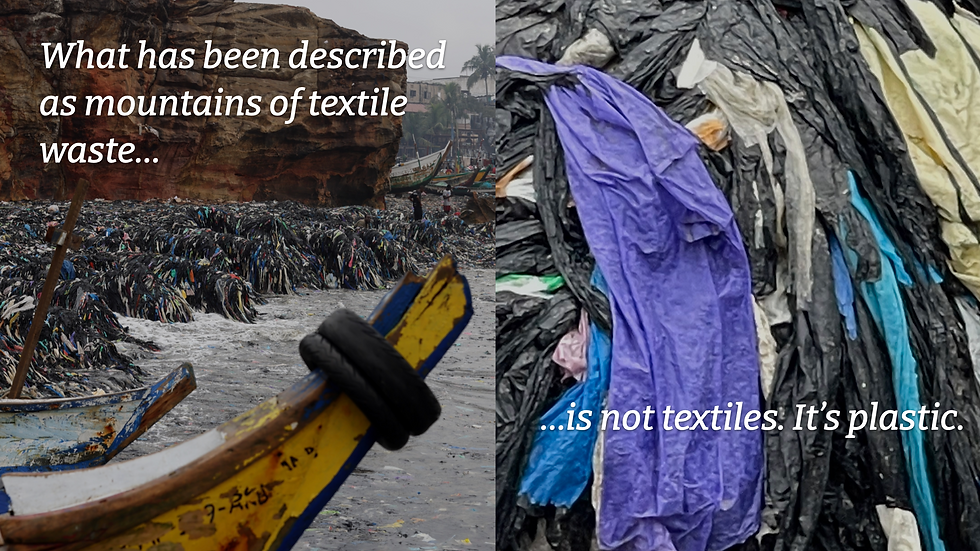
The question is whether the images and statistics that travelled around the world accurately reflected their scale.
Other questions remain unresolved.
Even where discarded garments are present, determining whether they originated from imported second-hand clothing, local consumption, manufacturing waste or other sources is often difficult. The evidence required to move from observation to attribution is rarely straightforward.
Critics also question the economic logic behind claims that large volumes of unsellable garments are routinely shipped halfway around the world only to become waste upon arrival.
"If we don't have the right information, then the wrong information is going to create the wrong perception, and the wrong perception is going to lead to wrong policies being formulated."
That concern is no longer limited to academic debates.
Today, the 40 percent figure continues to shape discussions around Extended Producer Responsibility, textile export restrictions, Basel Convention classifications and future regulation of the global second-hand clothing trade, but the evidence behind the claim remains contested.
The stakes extend far beyond a single statistic. The policies currently being discussed could influence the future of a trade that supports millions of livelihoods across Africa and provides affordable clothing to large parts of the population. Critics warn that restrictions based on inaccurate assumptions could reduce access to reuse markets, increase textile destruction in exporting countries and undermine one of the world's largest existing circular systems.
Written by
Thomas Lundkvist
Previous articles in this investigation:
Sources:
Shein Funding: Pressrelease
Laudes Foundation: Design for decomposition
The 2021 OR Foundation Report: Dead white man's clothes
Original Thesis
OR Foundation Tax filing
Editor's note:
The OR Foundation was given an opportunity to comment on the information and claims presented in this article. No response was received before publication. The organisation's perspective is therefore not reflected in this article.


Comments