Siptex closure highlights fiber-to-fiber market failures

Updated: Dec 17, 2025
The Swedish automated textile-sorting facility Siptex, widely regarded as the world’s first large-scale industrial plant of its kind, is now being offered for sale, its owner Sysav has confirmed. The decision marks a significant shift for the project, which was originally developed to help close the loop in textile recycling through advanced sorting technology.
Launched as part of a research and innovation initiative and later transitioned into full operation by Sysav in Malmö, Siptex uses near-infrared and visual spectroscopy to automatically sort post-consumer textiles by fibre type and colour — a critical step toward high-quality material recycling.
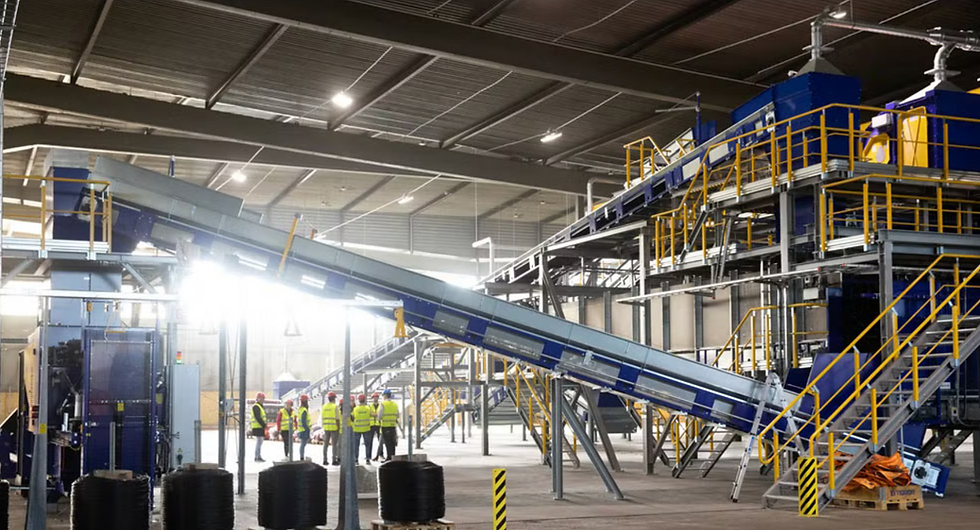
Sysav’s board unanimously decided to sell the facility after ongoing operational difficulties. Despite its innovative design and potential to enhance circularity in the textile value chain, Siptex has faced long periods of inactivity due to a lack of ready markets for sorted textile output and the bankruptcy of key industry partners.
As a result, roughly 1,200 tonnes of unsorted textiles remain at the plant with no buyer lined up.
Sysav CEO Malin Dahlroth said to Swedish newspaper Aftonbladet that the initiative was “an important and bold investment,” but acknowledged that the market and regulations have not evolved as quickly as needed since the facility’s inception.
Beyond the specific circumstances of this closure, the case highlights broader weaknesses in today’s fiber-to-fiber market. Large-scale textile sorting depends on stable downstream demand, predictable material flows, and pricing mechanisms that reward recycled fibers, conditions that are still largely missing. As long as recycled fibers struggle to compete with virgin alternatives, sorting facilities remain exposed to market volatility.
The shutdown therefore raises questions not only about one plant’s viability, but about whether the current system is structurally capable of supporting fiber-to-fiber recycling at scale.
The sale process will seek a buyer who can make use of the facility — potentially beyond textile sorting — but the future of the stored material remains uncertain if no buyer emerges.
Sources: Sysav
Comments