Is the environmental movements waste obsession hurting circularity?

Environmental organisations have spent decades fighting the export of waste from rich countries to poorer ones. It began with toxic waste, expanded to electronics and plastics, and has now reached second-hand clothing. But has a powerful environmental narrative become too simple for the circular economy it is trying to protect?
Within the Basel Convention, used textiles and textile waste have moved rapidly up the agenda. Governments are considering new ways of controlling transboundary movements, with further work now under way towards COP18 in 2027.
Environmental NGOs are pushing hard. Ahead of the Geneva meeting, more than 70 civil society organisations backed calls for stronger international controls, linking used-clothing exports to waste offshoring and what campaigners describe as a “reuse loophole”.
There is nothing remarkable about environmental organisations wanting stronger controls on waste.
The more difficult question is whether the underlying analysis is right.
Reuse News’ investigations into the textile waste narrative give reason to ask whether campaigners have sufficiently distinguished between exporting waste and trading goods and materials that still have value.
A familiar story
For decades, environmental campaigns have described international material flows through a familiar lens: rich countries produce too much and transfer the environmental consequences to poorer countries.
The argument has strong historical roots. Hazardous waste was shipped from industrialised countries to places poorly equipped to manage it. Later, discarded electronics exported to Africa and Asia exposed workers and communities to toxic substances.
But over time the same framework expanded.
Electronic waste became one of the defining environmental campaigns of the 2000s and 2010s. Images from Agbogbloshie in Ghana came to symbolise wealthy countries dumping unwanted computers and televisions on Africa.
The reality proved more complicated.
Research into used electronics entering Nigeria in 2015–2016 found illegal and non-functioning equipment. But it also found that around 81 percent of the used electronic equipment tested was functional.
The distinction between used goods traded for further use and waste disguised as used goods mattered enormously.
The parallels are striking
Journalist Adam Minter, who has spent years reporting on global recycling and second-hand markets, challenged the dominant portrayal of used electronics flowing from wealthy countries to Africa long before the same debate emerged around textiles.
Reporting from Ghana, Minter found serious pollution and unsafe recycling at Agbogbloshie. But he also found something largely missing from the familiar images of burning computers: a functioning economy in which imported electronics were sold, repaired and kept in use before eventually entering the waste stream.
He later argued that both used electronics and second-hand clothing had been unfairly stigmatised by the idea that exporting used goods from wealthy countries to developing economies was inherently suspect.
“There’s something dirty about exporting your used computer to Ghana,” he observed, adding that the same perception surrounded used clothing sent to Kenya and Tanzania.
His broader point was simple: circular economies cannot work if materials are expected to circulate only within the countries — or even continents — where they were first consumed.
When waste is also a resource
Metals expose the same tension.
Steel scrap may legally be classified as waste, but it is also an essential raw material for an increasingly circular and low-carbon steel industry.
The OECD has warned that restrictions on international scrap trade can reduce incentives for collection and recycling and make primary raw materials more competitive.
Sometimes crossing a border is not what turns a material into an environmental problem. It is what keeps it in use.

Now the same argument has reached clothing
Second-hand clothing is increasingly described using much of the same language once used around electronics and plastics: the Global North overconsumes, poorer countries receive the consequences, and Africa becomes a dumping ground.
Reuse News has spent more than a year examining that claim.
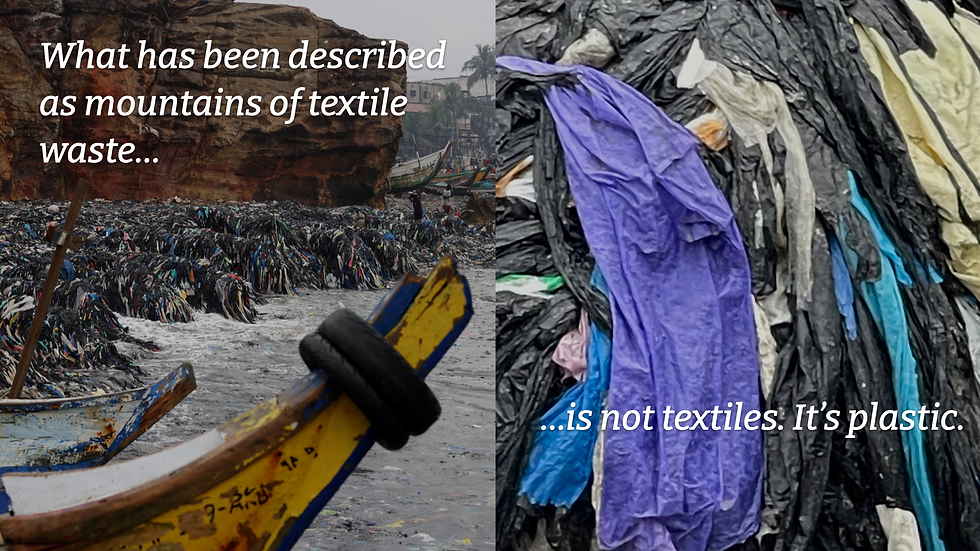
Our reporting in Ghana found that some of the images and statistics most widely used to illustrate a textile waste crisis were considerably harder to substantiate than the global debate suggested.
We have also examined how The OR Foundation helped popularise the claim that as much as 40 percent of clothing entering Ghana’s second-hand market becomes waste — a figure that subsequently travelled through media, research and policy despite remaining heavily contested.
More recently, we asked the European Commission and members of the European Parliament for robust evidence showing how much reusable clothing exported from Europe actually arrives as waste.
They did not provide it.
Our forthcoming review of the studies most frequently cited in the debate points to the same problem. Researchers have documented waste, pollution and serious local waste-management challenges. What remains weak is the evidence establishing that large shares of the international second-hand trade consist of waste at the point of import.
The existence of waste is not the same thing as proving its scale or cause.
Has the solution been thought through?
That creates an uncomfortable question for environmental organisations committed to both climate action and a circular economy. What if the diagnosis is wrong?
Reuse, repair and recycling depend on materials moving from places where they no longer have value to places where they do. Those markets do not necessarily stop at national borders.
A used computer may have little value in Sweden and considerable value in Nigeria. Steel scrap may be more efficiently recycled elsewhere. A second-hand garment with almost no resale value in Europe may still have years of useful life in Kenya, Ghana or Pakistan.
Stopping genuine waste exports is one thing. Making international reuse and recycling progressively more difficult is another. Yet terms such as “waste colonialism”, “dumping” and “offshoring” risk blurring that distinction by creating a moral picture in which exporting countries are perpetrators and importing countries victims.
If policies built around that narrative make reuse harder, reduce markets for secondary materials or encourage greater use of new products and virgin raw materials, environmental organisations may find themselves undermining some of the mechanisms a circular economy requires.
Rich countries clearly export waste.
The harder question is whether campaigners — and the policymakers listening to them — are distinguishing carefully enough between exporting waste to get rid of it and trading used goods and secondary materials because somebody else can use them.
For textiles, that distinction may now determine the future of a global second-hand economy.


Comments