How do you regulate a problem that may not exist?

The push to regulate textile waste exports began with the assumption that the problem was already understood. The Basel process has instead exposed fundamental uncertainty about what is actually being traded, what should count as waste and whether the problem exists in the form originally described.
When Reuse News examined the issue ahead of the Basel Convention meeting, the political direction appeared clear. Used clothing exports were increasingly being presented as a waste problem requiring international control. The remaining question seemed to be how the rules should be designed.
The meeting produced a very different picture.
Instead of moving directly towards new restrictions, the Basel process exposed how much remains uncertain. Governments and organisations described different problems, different markets and different meanings of the word waste. The evidence did not support one simple account of a global trade in unwanted clothing.
The process has now been forced back to a more basic stage. The Basel Convention is gathering experiences and data on trade in used textiles and textile waste. It is also examining the available regulatory options and the distinction between the two. The issue is expected to return when governments meet again at the next Conference of the Parties in 2027.
Used textiles or textile waste?
This may sound like a technical discussion, but the distinction has consequences far beyond customs procedures.
A used garment can be a donation, a commercial product, recycling material or waste, depending on its condition, its buyer and the market in which it arrives. The same item may have little value in one country and a clear use in another. Any international definition must somehow capture those differences while remaining simple enough for authorities to apply at borders.
That is not merely a bureaucratic challenge. It goes to the centre of how a circular economy is supposed to work.
When a waste definition becomes too broad
Markets for reuse depend on the possibility that goods can retain value after their first owner no longer wants them. If governments define waste too broadly, usable products may be caught in systems designed for disposal. Trade becomes more expensive, smaller markets become harder to serve and clothes that could have been reused may instead be destroyed closer to where they were collected.
What the evidence has not established
What the Basel process has not established is that the international second-hand trade as a whole resembles the waste trade described by some of its critics. That matters for the public debate.
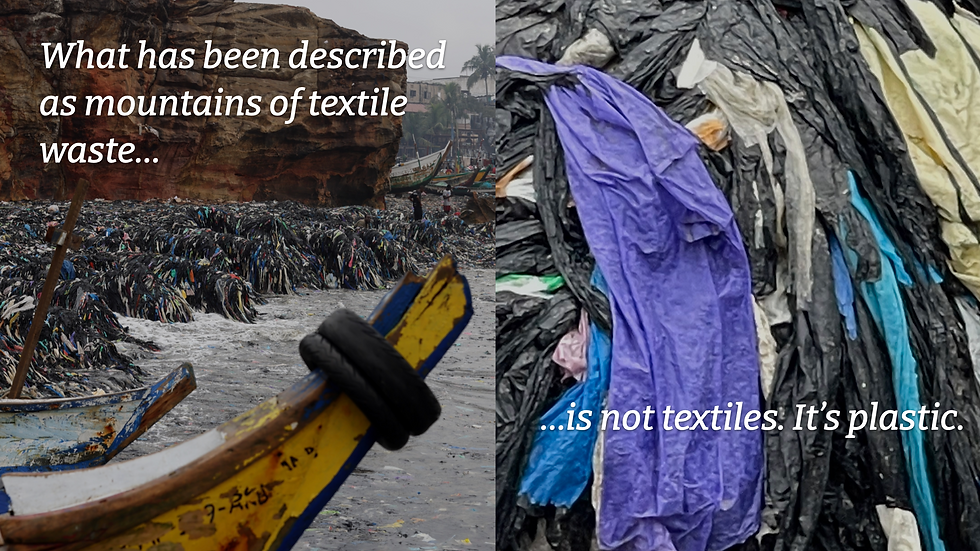
Images of polluted beaches and overflowing dumps have helped create the impression of a direct and well-documented chain from clothing collection in wealthy countries to environmental destruction elsewhere.
But when Reuse News examined locations presented as evidence of textile waste in Ghana, much of what appeared to be discarded clothing was actually plastic.
Previous Reuse News investigations have also found that the wider chain is often assumed rather than demonstrated. The commercial structure of the second-hand trade provides no obvious economic logic for systematically exporting unusable clothing as a product.
The presence of discarded clothing does not by itself prove that waste was exported. Nor does it prove that the clothing had no market value when it crossed the border, or that the problem exists on the scale commonly claimed.
Evidence before new controls
The next phase should therefore be judged by the quality of the evidence it produces, not by how quickly it delivers new controls. Governments need to understand what is traded, why it is traded, where genuine abuse occurs and what happens when legitimate reuse markets are restricted.
Basel began with pressure to regulate textile waste. It has arrived at the harder task of establishing what textile waste is and whether the original diagnosis was correct.
That is a reason to ensure that future rules address a problem that can be shown to exist, rather than one that has mainly been repeated.
Source:
Basel Convention Secretariat: Used textiles and textile waste overview.


Comments